
Sharing methodology documentation with peers works best when you treat your documents as living, version-controlled assets rather than static files you attach to an email and forget. The most effective approach combines three things: clear structure using formats like GitHub Flavored Markdown (GFM), a secure and accessible sharing platform, and a formal peer review process that invites genuine feedback. Get those three right, and your documentation becomes something colleagues can actually use, reproduce, and build on.
The core practices that make this work:
- Write documentation in GitHub Flavored Markdown so it renders cleanly, supports syntax highlighting and math formulas, and integrates naturally with version control workflows
- Choose platforms that offer permission controls, password protection, and direct shareable links rather than buried file directories
- Structure every document with a plain-language overview, numbered steps, materials or data requirements, and a references section
- Engage peers through a two-stage review: a minimum of two expert reviewers evaluate the document first, then a public comment period—commonly 14 days—for broader community input
- Treat knowledge sharing as a team habit, not a one-time handoff, with regular sessions and visible support from team leads
What is methodology documentation and why does sharing it matter?
Methodology documentation records the detailed procedures, protocols, and reasoning behind your research methods. It answers the question every reader eventually asks: "How exactly did you do this, and could I do it the same way?"
Sharing that documentation is what makes reproducibility possible. Without it, other researchers cannot validate your findings, build on your work, or catch errors before they propagate through a field. Funding agencies have taken notice. The NIH Data Management and Sharing Policy now requires researchers to plan for sharing not just data but the methods behind it, and the National Science Foundation has similar expectations. University research libraries at institutions like the University of Washington publish data sharing guidance that explicitly covers methodology as part of a complete research record.
The case for sharing goes beyond compliance. Open methodology documentation builds trust in your results, accelerates discovery by letting others skip steps you already solved, and positions your work for citation and collaboration. Yet open methodological documentation remains limited in many fields, with most publications still lacking reusable workflows or transparent peer review practices.
How to prepare methodology documents for effective sharing
Good preparation is the difference between a document that gets used and one that sits unread in a shared folder.
- Use GitHub Flavored Markdown. GFM renders tables, task lists, code blocks, and math formulas cleanly across platforms. It also integrates directly with Git repositories, so your documentation lives alongside your code or data rather than in a separate system.
- Include these sections in every document: a plain-language overview (two to three sentences), numbered step-by-step procedures, a materials or data requirements list, a data handling and ethics note, and a references section.
- Add a change log. Even a simple table listing the date, author, and what changed gives reviewers context and gives you an audit trail.
- Apply an open license. A Creative Commons license (CC BY 4.0 is the standard for research) signals that others can reuse your methods and tells them exactly how to credit you.
- Keep it concise. A document that tries to explain every background concept ends up explaining nothing well. Link to external references rather than reproducing them inline.
Pro Tip: Treat your methodology document as a file in your project repository, not a separate deliverable. When you update your code or protocol, update the doc in the same commit. Reviewers see the full context, and you never end up with a document that describes a method you stopped using six months ago.
The UCSF Library's data preparation guidance recommends structuring documentation so that a researcher unfamiliar with your project can reproduce your workflow without asking you a single question. That is a useful bar to write toward.
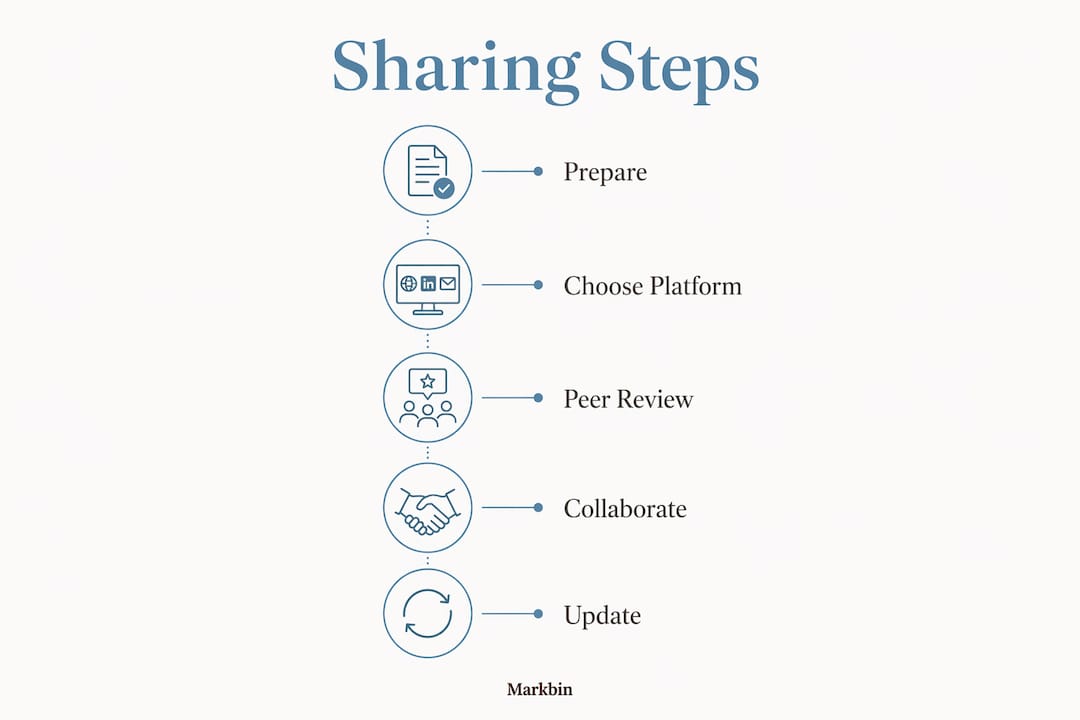
Which platforms work best for distributing research documentation?
The right platform depends on your team's size, your institution's requirements, and how much control you need over access.

Version-controlled repositories like GitHub or GitLab are the default choice for teams already working in code environments. Pull requests double as a peer review mechanism, and commit hashes give you an immutable record of every change.
Markbin fills a specific gap that repositories don't always cover: instant, beautifully rendered sharing without requiring every reviewer to have a Git account. You paste your GFM document, get a shareable link in seconds, and can add password protection or set the document to self-destruct after a set period. For sharing a methodology draft with an external collaborator who doesn't use GitHub, that matters. Markbin supports the full GFM spec, including syntax highlighting, tables, task lists, and math formulas, so nothing gets lost in translation between your editor and what your reviewer sees.
Institutional repositories handle compliance requirements. If your funder or institution requires that methodology documentation be publicly archived, platforms built for research data management provide the persistent identifiers (DOIs) and metadata standards that a GitHub repo does not.
Cloud storage with permission controls works for smaller teams or early-stage drafts, but it lacks version history and makes peer review harder to track.
Pro Tip: AI-powered search tools integrated into your documentation platform help colleagues find the right methodology document without digging through folder structures. Platforms like Contentelli offer this kind of discoverability layer for technical documentation teams.
For a deeper look at group document sharing methods that work across different team structures, the approaches translate directly to methodology workflows.
How to run a peer review process for methodology documents
Peer review of methodology documentation follows a structure that rigorous review processes have standardized: a minimum of two expert reviewers evaluate the document first, followed by a public comment period (commonly 14 days) for broader community input. That two-stage model catches both technical errors and usability problems that expert reviewers alone might miss.
A few practices make the process work in reality, not just on paper:
- Separate review from performance evaluation. Keeping methodology review distinct from any assessment of the author's performance removes the fear that honest feedback will have professional consequences. Reviewers give better notes when they know the goal is improving the document, not judging the researcher.
- Use iterative cycles. One round of feedback rarely produces a final document. Build in at least two review cycles, with versioned drafts between them so reviewers can see what changed.
- Frame feedback as dialogue. Communities of Practice that share expertise in the same domain produce more open, constructive feedback than blind review processes because reviewers feel safe asking questions rather than issuing verdicts.
- Set clear timelines and offer recognition. Reviewers who know exactly when feedback is due and see their contributions acknowledged are more likely to follow through.
Pro Tip: Ask reviewers to submit feedback as questions and suggestions rather than corrections. "I couldn't reproduce step 4 because X was unclear" is more useful than "Step 4 is wrong." It also makes the author more receptive.
Enhancing collaboration through markdown tools and a sharing culture
The technology side of sharing methodology documentation is only half the picture. The other half is organizational culture, and it tends to be the harder part.
Weekly knowledge sharing sessions of 30–60 minutes effectively combat the isolation that researchers and technical teams often feel, and they create a regular rhythm for surfacing methodology questions before they become blockers. The same research notes that 40% of employees report feeling isolated at work, and structured sessions directly address that. Recognizing the colleagues who actively facilitate decisions and resolve technical questions through documentation ("knowledge champions") drives more impact than simply tracking how many documents a team produces.
Executive participation is the single strongest driver of broad adoption. When team leads reference internal methodology documents in meetings and contribute to shared repositories themselves, it signals that documentation is a core practice, not a box-checking exercise.
Markdown's feature set directly supports the kind of documentation that teams actually use:
| Feature | Collaboration benefit |
|---|---|
| Syntax highlighting | Makes code-heavy methods readable without a separate IDE |
| Task lists | Tracks protocol steps and review action items inline |
| Math formulas | Renders statistical methods without external tools |
| Tables | Structures comparative data and parameter lists clearly |
| Version history via Git | Provides an audit trail and enables rollback to any prior state |
Combining these technical features with regular informal sessions transfers the tacit knowledge that no document fully captures. A methodology doc explains the what and the how. A 30-minute conversation with the person who wrote it explains the why, and that context is what makes the difference when a colleague tries to reproduce your work six months later.
For teams ready to put this into practice, Markbin offers a direct path from a markdown file to a shareable, rendered document with no setup required.
Key Takeaways
Effective methodology documentation sharing requires version control, clear structure, the right platform, and a peer review process that treats feedback as collaboration rather than critique.
| Point | Details |
|---|---|
| Use GitHub Flavored Markdown | GFM integrates with Git workflows and renders tables, code, and math formulas cleanly for reviewers. |
| Two-stage peer review | A minimum of two expert reviewers judge the document first, followed by a 14-day public comment period for broader community input—the standard for rigorous methodology review. |
| Separate review from evaluation | Keeping feedback distinct from performance assessment produces more honest, constructive reviewer notes. |
| Weekly sharing sessions | 30–60 minute sessions improve tacit knowledge transfer and reduce the isolation that 40% of researchers report. |
| Leadership drives adoption | Visible executive participation in documentation practices is the strongest predictor of team-wide uptake. |