
Shareable methodology documentation is the practice of creating and maintaining methodology files as living, version-controlled assets that enable collaboration, reuse, and continuous improvement across teams. Unlike static Word documents or private notes, this approach treats workflows as infrastructure: inspectable, testable, and portable. Modern practices like Docs as Code, GitHub Flavored Markdown (GFM), and single-source authoring have made it possible for professionals and students alike to build methodology documentation that compounds in value rather than decaying in a shared drive. The result is institutional knowledge that survives personnel changes and scales with organizational growth.
What is shareable methodology documentation and why does it matter?
Shareable methodology documentation is a version-controlled, living approach that treats workflows as assets written in lightweight markup and integrated into development pipelines. The phrase "shareable" is not just about access permissions. It means the documentation is structured, maintained, and formatted so any qualified reader can understand, execute, and improve upon the methodology without needing to ask the original author.

The industry term most closely aligned with this practice is Docs as Code, a methodology where documentation receives the same treatment as software: written in plain text, stored in version control systems like Git, reviewed via pull requests, and deployed through automated pipelines. This is the recognized standard behind what most professionals informally call "shareable methodology documentation."
The core components of this approach include:
- Version control: Every change is tracked with a record of who made it, when, and why. Version control adds visibility that static documents fundamentally lack, preserving the reasoning behind decisions for future evaluation.
- Living documents: Methodology files are updated continuously rather than published once and forgotten. A document that is six months out of date is not a resource. It is a liability.
- Single-source authoring: Content is created in one place and reused across multiple outputs using variables and snippets, eliminating the duplication that causes inconsistency across teams.
- Explicit ownership: Every document has a named owner responsible for updates. Without ownership, no one feels accountable, and documentation decays.
- Structured narration: The most accurate methodology documentation is produced when an expert performs a task while a second person documents in real time, capturing edge cases that solo sessions miss.
Pro Tip: Assign a documentation owner at the moment a new process is created, not after the fact. Retroactive ownership almost always produces incomplete records.
The distinction between narration and documentation is worth emphasizing. Structured narration captures tacit knowledge and edge cases that self-documentation routinely omits. When the person doing the work is also writing the steps, they unconsciously skip the parts that feel obvious to them. Those skipped parts are exactly what a new team member needs.
How does shareable documentation improve collaboration and resilience?
The most direct benefit of shareable methodology documentation is the elimination of knowledge silos. When a process lives only in one person's head or in a private notebook, the organization is one resignation away from losing it entirely. Moving workflows to version-controlled files transforms individual craft into collective institutional capability that can be inspected and improved by anyone with access.
"Good documentation reduces confusion and speeds onboarding by preserving critical knowledge beyond individual memory." — Mimo Glossary
This matters most during onboarding. A new hire who can read a well-structured methodology document on day one reaches productive contribution faster than one who must shadow colleagues for weeks. The documentation becomes a self-service knowledge base that scales without requiring senior staff to repeat the same explanations.
Operational resilience is the less-discussed benefit. Teams that maintain current methodology documentation can absorb disruption, whether that is a key employee leaving, a process audit, or a rapid pivot in strategy, without losing continuity. The documentation serves as the organization's memory. When that memory is version-controlled, the team can also trace exactly when a process changed and why, which is invaluable during post-mortems or compliance reviews.
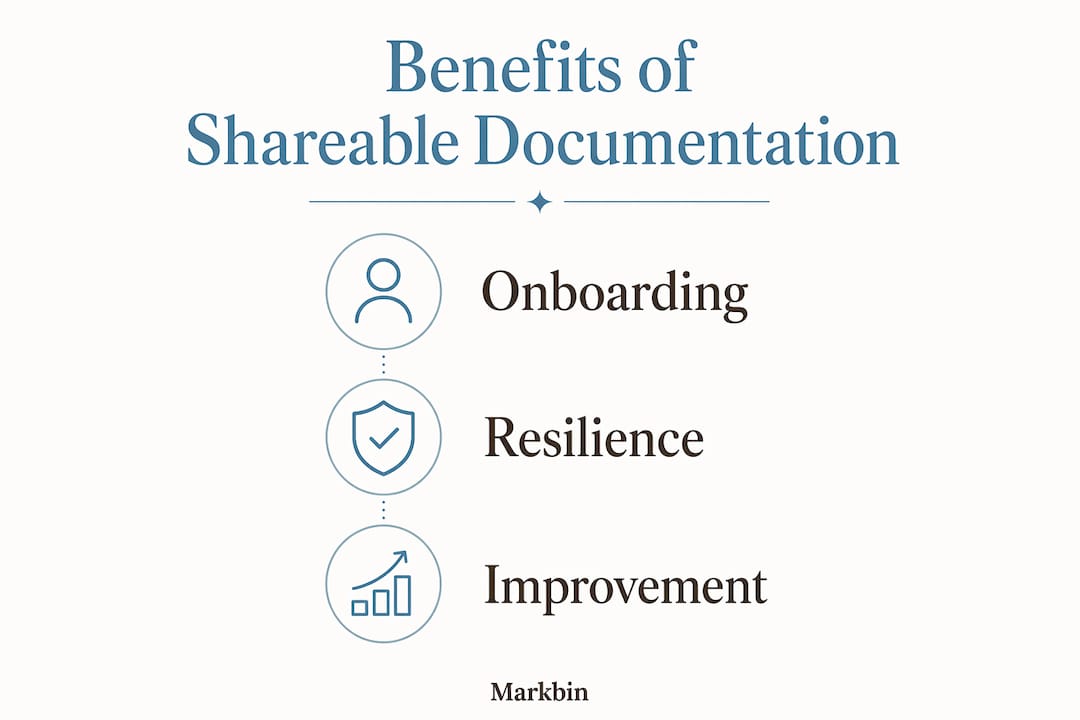
Continuous improvement is the third major gain. When methodology files are readable and testable, teams can identify bottlenecks, propose changes via pull requests, and track the impact of those changes over time. Knowledge compounds rather than resets with each personnel change. This is the difference between an organization that learns and one that repeatedly rediscovers the same lessons.
What tools and formats work best for methodology documentation?
The format choice is not cosmetic. It determines whether your documentation can be version-controlled, searched, rendered, and shared without friction.
| Format / Tool | Best For | Key Limitation |
|---|---|---|
| Markdown (GFM) | Human-readable, version-controlled docs | Requires a renderer for full visual output |
| Git / GitHub | Version control, pull request reviews | Learning curve for non-developers |
| Confluence | Team wikis and structured pages | Proprietary, harder to version-control |
| Google Docs | Quick collaboration and comments | No native version control or diff views |
| DITA XML | Enterprise single-source authoring | High complexity, steep setup cost |
Markdown is the format of choice for most Docs as Code workflows because it is efficient for professional authoring and renders cleanly across platforms. It supports syntax highlighting, tables, task lists, and math formulas without requiring HTML knowledge. GitHub Flavored Markdown extends the standard with features like checkboxes and fenced code blocks, making it practical for technical methodology documentation.
Git provides the version control layer. Every commit records what changed, who changed it, and the message explaining why. Pull requests add a review gate, so methodology updates go through the same scrutiny as code changes. This is how teams make updates a formal requirement rather than an afterthought.
For teams encoding methodology as portable skill files, Markdown with structured metadata headers offers a durable format that is diffable, testable, and independent of any specific tool or reasoning engine. The methodology becomes an artifact the organization owns, not one locked inside a proprietary platform.
Platforms that support secure Markdown sharing via controlled links add a practical distribution layer, allowing teams to share rendered documentation without exposing the raw repository to every stakeholder.
What are the best practices for creating methodology documentation?
Effective shareable methodology documentation follows a repeatable process. Here are the steps that consistently produce the highest-quality results:
- Separate narration from documentation. Have the subject matter expert perform the task while a dedicated documenter captures each step in real time. This two-person method surfaces the tacit knowledge and exception handling that solo documentation misses every time.
- Assign explicit ownership before publishing. Every document needs a named owner with a defined review cadence. Documentation reviewed at least quarterly with owners updating within 5 to 7 business days after process changes maintains operational accuracy.
- Use single-source authoring from the start. Write each methodology once and reference it across multiple documents using variables or snippets. Rewriting the same content in multiple places guarantees inconsistency within months.
- Store everything in version control. Commit methodology files to Git or an equivalent system from day one. A document that exists only in a shared drive has no history, no accountability, and no way to recover from accidental edits.
- Write for the reader who was not in the room. Every step should be explicit enough that someone unfamiliar with the process can execute it without asking for clarification. If a step requires context, add it inline rather than assuming prior knowledge.
- Review and update after every significant process change. Documentation decay is the most common failure mode. A methodology document that does not reflect current practice is worse than no document at all, because it creates false confidence.
Pro Tip: Use pull request templates in Git to require a documentation update check before any process-related code change is merged. This makes documentation maintenance a structural habit rather than a voluntary one.
Common pitfalls to avoid include skipping the ownership assignment, treating the first draft as final, and structuring documentation around how the process was built rather than how it should be executed. The disciplined development approach applied to documentation workflows produces the same quality gains it delivers in software: fewer defects, faster onboarding, and more reliable outputs.
Key takeaways
Shareable methodology documentation works because it combines version control, explicit ownership, and structured formats to transform individual knowledge into durable, collective institutional assets.
| Point | Details |
|---|---|
| Version control is non-negotiable | Git-based tracking records who changed what and why, preventing knowledge decay over time. |
| Structured narration beats self-documentation | Two-person capture sessions surface tacit knowledge and edge cases that solo authors consistently miss. |
| Single-source authoring prevents drift | Writing methodology once and reusing it across outputs eliminates the inconsistency that multi-copy documents create. |
| Quarterly reviews maintain accuracy | Assigning explicit owners with a defined cadence keeps documentation current after every process change. |
| Format determines shareability | Markdown with Git provides the portability, diff visibility, and rendering quality that proprietary formats cannot match. |
Why I think most teams are still treating methodology as a side project
I have reviewed documentation practices across research teams, software organizations, and academic departments, and the pattern is consistent. Methodology documentation gets created once, usually under deadline pressure, and then left to age. The team moves on, the process evolves, and the document becomes a historical artifact that no one trusts but everyone still references.
The shift that actually works is treating methodology as infrastructure, not as a deliverable. Infrastructure gets maintained because the cost of neglect is visible and immediate. A broken pipeline stops work. An outdated methodology document just quietly misleads people, and the damage only surfaces weeks later when a new hire executes a deprecated process or a client receives inconsistent outputs.
What I find most underused is the pull request review model applied to documentation. When a methodology change requires a pull request, it forces the team to articulate what changed and why. That articulation is the institutional knowledge. The diff is the record. Most teams skip this entirely because it feels like overhead, but it is the mechanism that makes documentation a living system rather than a snapshot.
The cultural shift required is modest but real. Teams need to accept that writing is part of the work, not a task that happens after the work is done. When that norm takes hold, methodology documentation stops being a burden and starts being the most reliable colleague on the team.
— Zack
How Markbin helps you build and share methodology documentation
Markbin is built for exactly this workflow. You write in GitHub Flavored Markdown, and Markbin renders it instantly into a clean, shareable document with full support for syntax highlighting, tables, task lists, and math formulas. No sign-up required to share. No formatting overhead. You can protect sensitive methodology documents with password access, set documents to self-destruct after a defined period, and distribute rendered links across any channel your team uses. For professionals and students building documentation for teams, Markbin removes the friction between writing and sharing so the methodology reaches the people who need it without delay.
FAQ
What is the difference between methodology documentation and regular documentation?
Methodology documentation captures how a process is executed, including the reasoning, edge cases, and decision points. Regular documentation often describes what a system does without explaining the workflow logic behind it.
How often should methodology documentation be updated?
Methodology documentation should be reviewed at least quarterly, with updates made within 5 to 7 business days after any significant process change to prevent knowledge decay.
What format is best for shareable methodology documentation?
Markdown stored in a Git repository is the most portable and version-controllable format. It renders cleanly across platforms, supports technical content like code blocks and tables, and integrates naturally into Docs as Code workflows.
What is single-source authoring in methodology documentation?
Single-source authoring means writing methodology content once and reusing it across multiple documents or outputs using variables and snippets. This prevents the inconsistency that results from maintaining duplicate copies of the same information.
Can methodology documentation be used for AI tools and agents?
Yes. Methodology encoded as structured Markdown files with metadata headers can be used as portable skill files for AI agents. These files are diffable, testable, and maintainable independent of any specific reasoning engine, making them a durable format for encoding institutional knowledge.