
Sharing assignment drafts for peer feedback is defined as a structured process where students submit in-progress writing to classmates for guided critique before final submission. This practice, formally called peer review, builds both writing quality and critical thinking. Platforms like Canvas, Blackboard, Harmonize, and Packback Writing support this process with built-in rubrics, deadline controls, and anonymous reviewer assignment. When done correctly, peer review gives students formative feedback while ideas are still forming, which produces deeper revisions than last-minute proofreading ever could.
What do you need to share assignment drafts for peer feedback?
The right setup prevents the most common peer review failures before they happen. Three elements are non-negotiable: a platform that supports draft submission, a structured rubric, and two separate deadlines.
Platforms that support peer review workflows

Learning Management Systems are the most common starting point. Canvas, Blackboard, and Harmonize each include native peer review modules that handle draft collection and reviewer assignment automatically. Packback Writing adds AI-assisted prompts that guide reviewers toward specific, useful comments. Each platform handles the logistics differently, but all require the instructor to configure the assignment before students submit.
Rubrics and feedback forms
A rubric is not optional. Clear assignment criteria anchor reviewer attention and reduce vague or irrelevant feedback. Without one, reviewers default to surface-level comments like "good job" or "needs more detail." A well-built rubric breaks feedback into categories: argument clarity, evidence quality, structure, and mechanics. Each category should include a guiding question the reviewer must answer.
Deadlines: the most overlooked prerequisite
LMS platforms commonly lack support for separate due dates for draft submission and peer review phases. Instructors must communicate both deadlines explicitly in assignment instructions. Missing this step causes students to submit drafts and reviews simultaneously, which defeats the purpose of the cycle.
- Set a draft submission deadline at least 3 days before the feedback deadline.
- Publish both deadlines in the assignment description, not just in a separate announcement.
- Use completion-based grading for the review phase. Completion-based grading raises participation by 20–30% compared to optional reviews.
- Brief reviewers before the assignment opens, not after.
Pro Tip: Run a calibration exercise before the first peer review. Share an instructor-graded sample draft and ask students to score it using the rubric. Discuss the results as a class. This single step improves feedback accuracy more than any rubric revision.
| Tool | Best for | Key limitation |
|---|---|---|
| Canvas | LMS-integrated workflows | Limited separate deadline support |
| Blackboard | Large institutional deployments | Complex setup for first-time users |
| Harmonize | Discussion-based annotation | Requires separate subscription |
| Packback Writing | AI-guided feedback prompts | Cost per student |
| Markbin | Secure markdown draft sharing | No built-in LMS grade sync |
How do you share drafts and manage peer feedback in practice?
The mechanics of sharing drafts vary by platform, but the underlying workflow is consistent across all of them.
Submitting and distributing drafts
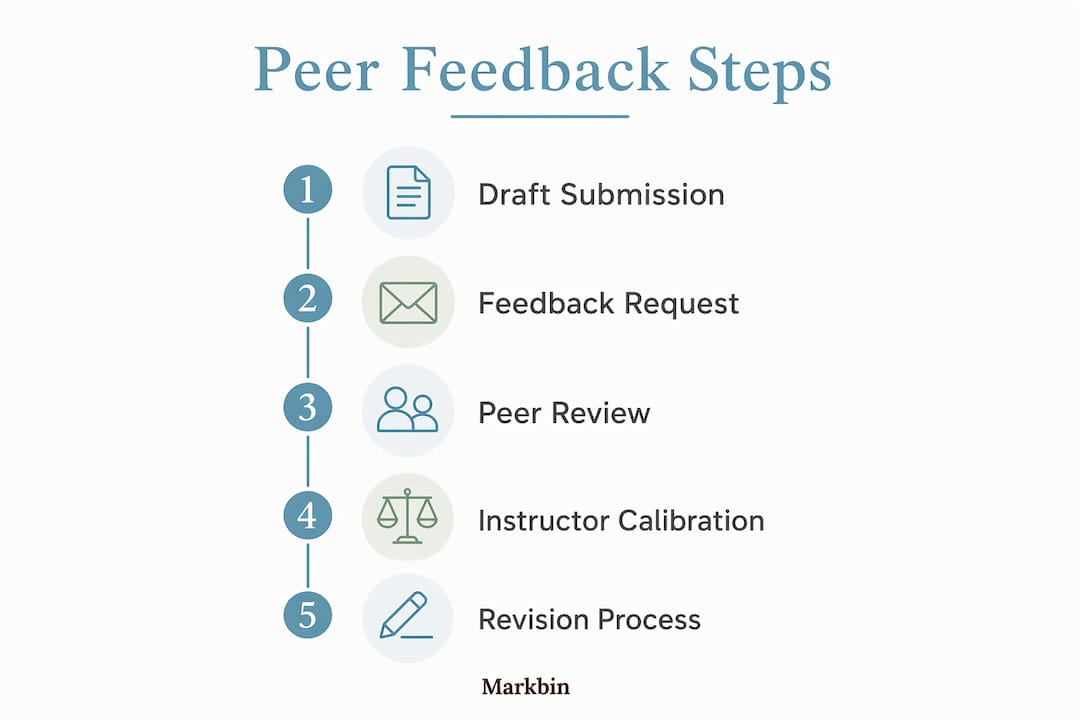
- The instructor creates the peer review assignment in Canvas or Blackboard and sets both the draft submission deadline and the feedback deadline.
- Students submit their drafts as file uploads or inline text before the first deadline.
- The platform automatically assigns each student one or more reviewers. Anonymous assignment prevents social bias from affecting feedback quality.
- Reviewers open the assigned draft and complete the rubric-guided feedback form.
- Authors receive completed reviews and begin revisions before the final submission deadline.
Including a feedback request note
Students should attach a short note to their draft explaining what kind of feedback they want. Explicit feedback requests from draft authors help focus peer reviewers and improve feedback relevance. A two-sentence note works well: one sentence describing the draft's current stage, and one sentence naming the specific area where feedback matters most.
Running multi-round review cycles
Single-round reviews produce limited learning. Multi-round workflows that include draft submission, peer review, revision, and resubmission encourage meaningful revisions and let instructors track improvement between drafts. Tracking changes between versions also helps instructors assess whether students acted on the feedback they received.
- Use annotation tools that support inline comments rather than general end-notes.
- Annotation loop workflows with inline comments compiled into actionable items improve feedback resolution to 100%.
- Mark each comment as resolved once the author addresses it. This creates a visible record of revision decisions.
- Repeat the cycle for high-stakes assignments. Two rounds of peer review produce noticeably stronger final drafts than one.
Pro Tip: When sharing drafts outside an LMS, use a markdown-based tool like Markbin. Convert your draft to markdown, generate a shareable link, and send it to reviewers. Reviewers can read a cleanly formatted version without needing an account. Add password protection for sensitive assignments.
What are the best practices and common mistakes in peer feedback?
The quality of peer feedback depends almost entirely on how well the process is designed before students touch it. Most failures trace back to three root causes: vague instructions, missed deadlines, and untrained reviewers.
"Peer review is most beneficial when integrated early and structured with clear prompts rather than treated as a disconnected final step." — Packback
Mistakes that kill feedback quality
Failure to submit drafts on time causes manual reassignment of reviewers and can delay feedback for up to 15–20% of a class. Late submissions break the automatic assignment logic in most LMS platforms, forcing instructors to reassign manually. This delays the entire cohort.
Vague rubrics produce vague feedback. A rubric that says "check for clarity" gives reviewers nothing to act on. Replace it with "Does the thesis statement appear in the first paragraph? Is it arguable?" Specific questions produce specific answers.
Practices that consistently improve outcomes
Reviewer training with calibration exercises using instructor-graded samples increases peer review feedback quality significantly. This is the single highest-leverage action an instructor can take before a peer review cycle opens.
Early feedback is more valuable than late feedback. When students receive critique while ideas are still forming, they make intentional revisions. Feedback received the day before final submission leads only to surface corrections.
Secure link sharing matters for academic work. Sharing drafts through open, unprotected links exposes student writing to unintended audiences. Use platforms that offer password-protected sharing or access-controlled links for any assignment containing personal or sensitive content.
LMS peer review tools vs. third-party annotation platforms
Choosing between a built-in LMS peer review module and a third-party annotation platform comes down to three factors: integration depth, feedback quality, and cost.
| Feature | LMS native tools (Canvas, Blackboard) | Third-party platforms (Harmonize, Packback, Markbin) |
|---|---|---|
| Setup complexity | Low, built into existing course | Moderate, requires separate configuration |
| Rubric support | Basic, form-based | Advanced, with AI-guided prompts |
| Inline annotation | Limited or absent | Full inline commenting and resolution tracking |
| Anonymous review | Supported | Supported |
| AI feedback assistance | Rare | Available in Packback and annotation loop tools |
| Cost | Included with LMS license | Per-student or subscription pricing |
| Secure link sharing | Not available outside LMS | Available in Markbin and similar tools |
LMS tools work well for straightforward assignments where the goal is participation and basic critique. Third-party platforms add value when the assignment requires detailed inline annotation, multi-round revision tracking, or AI-assisted feedback prompts.
Markdown-based collaboration prevents version control fragmentation and keeps feedback accessible in one place. Embedding comments alongside text lets both human reviewers and AI agents address feedback without creating scattered document versions. For instructors managing large classes, this reduces the overhead of tracking which comments were resolved.
The future of peer review blends human feedback with AI agents that track and resolve comments, enhancing collaboration effectiveness. This is not a distant development. Tools like Packback Writing already use AI to flag low-quality reviews before authors receive them.
Key takeaways
Structured peer review with separate deadlines, trained reviewers, and rubric-guided prompts produces the highest-quality feedback and the most meaningful student revisions.
| Point | Details |
|---|---|
| Set two deadlines | Separate draft submission and feedback deadlines to prevent simultaneous submission. |
| Train reviewers first | Calibration exercises with instructor-graded samples improve feedback accuracy before the cycle begins. |
| Use rubric-guided prompts | Specific rubric questions produce specific, useful comments instead of vague praise. |
| Start feedback early | Early-stage feedback drives intentional revision; late feedback produces only surface corrections. |
| Choose tools by need | LMS tools cover basic workflows; annotation platforms add inline comments, AI prompts, and secure sharing. |
Why most peer review fails before it starts
Most peer review problems are design problems, not student problems. I have watched instructors build careful rubrics and then open the assignment with a single deadline, expecting students to figure out the sequence on their own. They do not. The draft and the review arrive at the same time, and the whole point of the cycle collapses.
The fix is not a better rubric. The fix is sequencing. Draft deadline first, feedback deadline second, revision window third. That structure forces the behavior you want. Without it, even the most motivated students default to last-minute compliance.
The other thing I keep seeing underused is calibration. Instructors spend hours writing rubrics and almost no time teaching students how to use them. One calibration session, where the class scores the same sample draft together and discusses disagreements, does more for feedback quality than any rubric revision. Students leave that session with a shared understanding of what "good feedback" actually looks like.
My honest recommendation: if your LMS does not support separate deadlines cleanly, do not fight the platform. Use a simple external tool for draft sharing and keep the LMS for grade recording. Markbin works well here. Students paste their draft in markdown, generate a link, and share it with assigned reviewers. No account required, no version confusion, and the instructor can add password protection for sensitive work. Pair that with a Google Form for structured feedback collection and you have a functional peer review workflow that costs nothing extra.
The annotation loop approach is worth adopting for upper-division courses. Inline comments that get marked as resolved create a visible revision record. That record is useful for grading and for students who want to see how their thinking changed across drafts.
— Zack
Markbin makes draft sharing simple and secure
Peer review workflows break down when sharing is clunky. Markbin solves that directly. Students paste their draft as markdown, generate a shareable link in seconds, and send it to reviewers without creating an account. Instructors can require password protection for sensitive assignments, set links to self-destruct after the review window closes, and share formatted academic drafts that render cleanly on any device. Markbin supports GitHub Flavored Markdown, so tables, task lists, and structured feedback prompts all display correctly. For educators who want a lighter alternative to full LMS peer review modules, Markbin fits naturally into any existing workflow without a subscription.
FAQ
What is the best way to share assignment drafts for peer feedback?
The most effective method combines a structured LMS workflow with a separate draft-sharing tool for inline annotation. Submit drafts through Canvas or Blackboard for grade tracking, and use a markdown sharing tool like Markbin for clean, accessible reviewer links.
How many reviewers should each student receive?
Two to three reviewers per draft is the standard for most undergraduate assignments. Multiple reviewers surface different perspectives and reduce the impact of one low-quality review.
Why do LMS platforms struggle with peer review deadlines?
Most LMS platforms do not support distinct due dates for draft submission and peer review phases. Instructors must communicate both deadlines explicitly in assignment instructions to prevent simultaneous submission.
How do you improve the quality of peer feedback comments?
Reviewer calibration with instructor-graded sample drafts and rubric-guided prompts consistently produces higher-quality feedback. Training reviewers before the cycle opens is more effective than correcting poor feedback after the fact.
Can peer review work without an LMS?
Yes. A combination of a secure draft-sharing platform, a structured feedback form, and clear deadlines replicates the core LMS peer review workflow without institutional software.