
Sharing meeting notes from study groups is the process of distributing key decisions, assigned tasks, and action items so every group member stays aligned after each session. Groups that share notes well retain more, miss fewer deadlines, and spend less time repeating themselves at the next meeting. The standard industry term for this practice is collaborative documentation, and it covers everything from formatting choices to timing and access controls. Done right, it turns a private record into a group accountability tool that compounds in value over time.
How to share meeting notes from study groups effectively
The single most important rule is timing. Share notes within 1 hour of the session to preserve accuracy and context. Delays beyond 24 hours cause significant memory loss, and details that felt obvious in the room become ambiguous by the next morning. That one-hour window is the standard recommended by documentation experts in 2026, and it applies even if the notes are still rough.
The second rule is clarity of purpose. Effective notes focus on two questions: "What was decided?" and "Who is doing what?" Everything else is optional. Groups that try to transcribe every word end up with documents nobody reads.

Sharing notes also changes the meeting itself. Visible notes allow attendees to confirm decisions and correct misunderstandings in real time. That shift from private record to shared document creates accountability before anyone even leaves the room.
What tools and prerequisites do you need before sharing?
Choosing the right tool matters more than most groups realize. The core feature to look for is the ability to distinguish between read-only sharing and collaborative editing. Read-only defaults protect original notes from accidental changes while still giving everyone access. Collaborators who want to annotate can save their own copy.
Beyond access controls, look for these feature categories when evaluating any note-sharing tool:
| Feature category | Why it matters |
|---|---|
| Shareable links | Provide permanent access without requiring email forwarding |
| Read-only vs. editable modes | Prevent accidental changes to the source document |
| Password protection | Restricts access to group members only |
| Searchable archive | Lets groups retrieve past decisions quickly |
| Formatting support | Preserves headings, tables, and task lists across devices |
Shareable links outperform email for recurring meetings because they preserve formatting and provide a permanent URL. Forwarding a document as an email attachment creates version confusion fast.
Pro Tip: Always share a read-only version first. If group members need to add comments or corrections, send a separate editable copy. Mixing the two in one link is the fastest way to lose your original notes.
How to organize and format notes for clarity
Structure is what separates a useful document from a wall of text. Lead every set of notes with the meeting purpose, the date, and the names of attendees. That context takes ten seconds to add and saves minutes of confusion later.
Every set of shared study group notes should include:
- Meeting purpose: One sentence stating what the group was trying to accomplish
- Key decisions: Bullet points, not paragraphs
- Action items: Each one labeled with an owner, a deliverable, and a deadline
- Open questions: Items that need more research or a follow-up decision
- Next steps: What happens before the next meeting
Action items must have specific owners and deadlines. Vague phrasing like "we should look into this" is not an action item. It is a wish. The difference between "someone will handle the bibliography" and "Priya will send the formatted bibliography to the group by friday at noon" is the difference between done and forgotten.
Formatting also affects how notes get used. Use H2 headings for major sections, bullet points for action items, and bold text for deadlines. Keep paragraphs short. Structured tagging with labels like #questions, #resources, and #actions makes notes searchable and prevents important items from getting buried.
Pro Tip: Treat your shared notes like a mini publication. Apply the same editorial discipline you would to a group report. That mindset shift alone improves the quality of what gets written and shared.
Step-by-step process for sharing study group notes
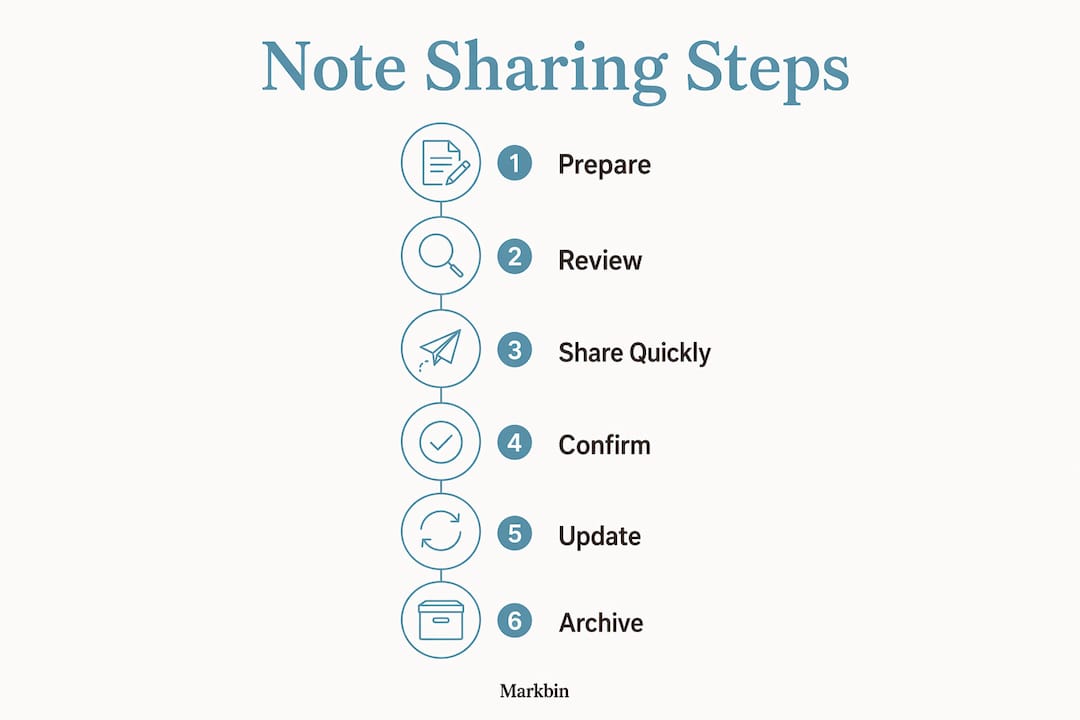
A repeatable workflow removes the guesswork and keeps every group member on the same page. Here is the process that works:
-
Assign a note-taker before the meeting starts. Rotate this role each session so no one person carries the burden every time. Alternatively, use AI transcription tools to handle the full workflow, including transcription, structured notes, and action extraction, with one person reviewing the output.
-
Capture decisions and action items during the meeting. Do not wait until after. Write down what was decided as it happens, not what was discussed. Discussion is context. Decisions are the record.
-
Clean up and share within one hour. Fix typos, confirm owners and deadlines, and add any missing context. Then send the link. A slightly rough set of notes shared in 45 minutes beats a polished document sent the next morning.
-
Use a shareable link, not an attachment. Paste the link into your group chat, email thread, or shared workspace. This gives everyone the same version and avoids the "which file is current?" problem. For student groups, sharing study notes via link also makes it easy to reference specific sessions later.
-
Ping action item owners after 48 hours. A short message like "Hey, just checking in on the outline due friday" catches blockers early. Follow-up at 48 hours is the standard recommended for keeping accountability without being overbearing.
-
Open the next meeting with a review of prior action items. Starting each session with a review of what was supposed to happen builds continuity and signals that the notes actually matter.
This six-step loop takes less time than most groups spend re-explaining what was decided at the last meeting.
What common mistakes should you avoid when sharing notes?
Most note-sharing failures come from the same small set of errors. Recognizing them is the first step to fixing them.
-
Sharing too late. Notes sent 24 hours or more after a meeting lose context fast. The group moves on, and the document becomes a historical artifact instead of a working tool.
-
Missing owners and deadlines on action items. An action item without a name attached to it belongs to no one. It will not get done.
-
Over-documenting. Capturing every comment and tangent creates noise. Readers stop reading. Focus on decisions and next steps only.
-
Sending editable files when read-only is appropriate. One accidental edit to the source document can corrupt the group's shared record. Use secure link sharing to control who can change what.
-
Storing notes in scattered locations. Notes in three different apps, two email threads, and a group chat are effectively lost. A searchable archive of all past sessions creates a compounding knowledge asset. Groups that maintain one builds on prior work instead of repeating it.
High-quality shared notes reduce duplicated effort and help absent group members catch up without needing a full debrief. One strong document can save the group hours of repeated explanation.
Key takeaways
Sharing study group notes within one hour, in a structured format with clear owners and deadlines, is the single practice that most reliably turns meetings into progress.
| Point | Details |
|---|---|
| Share within one hour | Notes shared promptly preserve accuracy and reduce context loss after the session. |
| Use read-only links | Protect source documents by sharing view-only links and keeping editable copies separate. |
| Assign owners and deadlines | Every action item needs a name, a deliverable, and a due date to get done. |
| Tag and archive consistently | Structured labels and a central archive make past notes searchable and reusable. |
| Review notes at the next meeting | Opening each session with a prior action review builds accountability and continuity. |
Why structured note sharing changed how I think about study groups
Most groups treat note sharing as an afterthought. Someone types up what they remember, drops it in the chat two days later, and considers the job done. I used to think that was fine. After watching dozens of groups stall out mid-semester, I changed my mind.
The groups that actually finish strong share notes fast and make them specific. Not because they are more disciplined by nature, but because the notes themselves change how people show up. When you see your name next to a deadline in a shared document, the task becomes real in a way that a verbal agreement never does. That is not a motivational observation. It is a structural one.
The other thing most articles miss is the benefit for absent members. Collaboration in group settings depends on everyone having access to the same information. When one person misses a session, a well-structured set of notes gets them back up to speed in five minutes. Without it, the group spends the first ten minutes of the next meeting re-explaining decisions. That time adds up.
My honest recommendation: treat your notes like a product. Give them structure, give them owners, and share them on a schedule. The groups I have seen do this consistently outperform the ones that wing it, every time.
— Zack
Markbin makes note sharing simple for study groups
Study groups need a place to write, format, and share notes without fighting with file attachments or access permissions. Markbin converts plain markdown text into clean, shareable documents with a single link. You get full support for GitHub Flavored Markdown, including task lists, tables, and headings, so your notes look organized on any device. Password protection and self-destructing documents give you control over who sees what and for how long. No sign-up is required to start. If your group is ready to stop losing notes in email threads, try Markbin and share your next session's notes in under a minute.
FAQ
How soon should you share meeting notes after a study session?
Share notes within one hour of the session. Delays beyond 24 hours cause significant context loss and reduce the document's usefulness for the group.
What should every set of study group notes include?
Every set of notes should include the meeting purpose, key decisions, action items with owners and deadlines, open questions, and next steps.
What is the difference between read-only and editable note sharing?
Read-only sharing gives group members access to view the document without changing it. Editable sharing allows changes, which risks accidental edits to the source record.
How do you keep study group notes organized over a full semester?
Maintain a searchable archive in one central location and use consistent tags like #actions, #questions, and #resources. Review prior notes at the start of each meeting to build continuity.
Why do action items fail in shared study group notes?
Action items fail when they lack a specific owner, deliverable, or deadline. Vague phrasing like "someone will handle it" assigns responsibility to no one.