

Most students think a study guide is just a cleaned-up version of their class notes. It isn't. A shareable study guide, more precisely called a collaborative study resource, is a structured document built from the start to be accessed, used, and improved by more than one person. Understanding what is a shareable study guide and how to build one effectively changes how groups prepare for exams, how educators distribute materials, and how knowledge actually sticks. This article covers definitions, formats, design principles, and the research on when shared guides help most.
Table of Contents
- Key takeaways
- What is a shareable study guide
- Formats and technologies for distribution
- Best practices for designing effective study guides
- When and how to use shared guides for group and solo study
- My take on where most study guides go wrong
- Create and share study guides with Markbin
- FAQ
Key takeaways
| Point | Details |
|---|---|
| Shareable guides differ from notes | They are structured for multi-user access, clarity, and collaborative use, not just personal reference. |
| Format determines accessibility | Self-contained files and link-based sharing remove friction and boost participation significantly. |
| Group size matters | Groups of 3 to 5 see the best outcomes; larger groups lose accountability and focus. |
| Active learning beats passive copying | Techniques like Feynman explanations and practice questions inside guides deepen retention. |
| Frictionless access is non-negotiable | Requiring logins or app downloads before someone can open a guide drastically reduces its use. |
What is a shareable study guide
A shareable study guide is a purposefully designed document that consolidates course content into an accessible, structured format others can open, read, and contribute to without needing extra context. This distinguishes it fundamentally from personal notes, which are written for one brain and one workflow.
The core purposes of a shareable study resource are three:
- Collaboration: Multiple students can build on one document, divide topics, and pool understanding rather than each duplicating the same work.
- Resource exchange: Educators and students distribute materials across a class, cohort, or study group without converting, printing, or reformatting.
- Accountability: When a group agrees on one guide, everyone works from the same source. There is no ambiguity about what content is in scope.
What separates a genuinely shareable guide from a document someone happened to email is design intent. A good one prioritizes clarity over completeness, uses headings and visual hierarchy so readers can navigate it without explanation, and stays light enough to open on any device. It includes concrete examples, not just definitions. It uses tables, diagrams, or quizzes where a paragraph would fail to communicate structure.
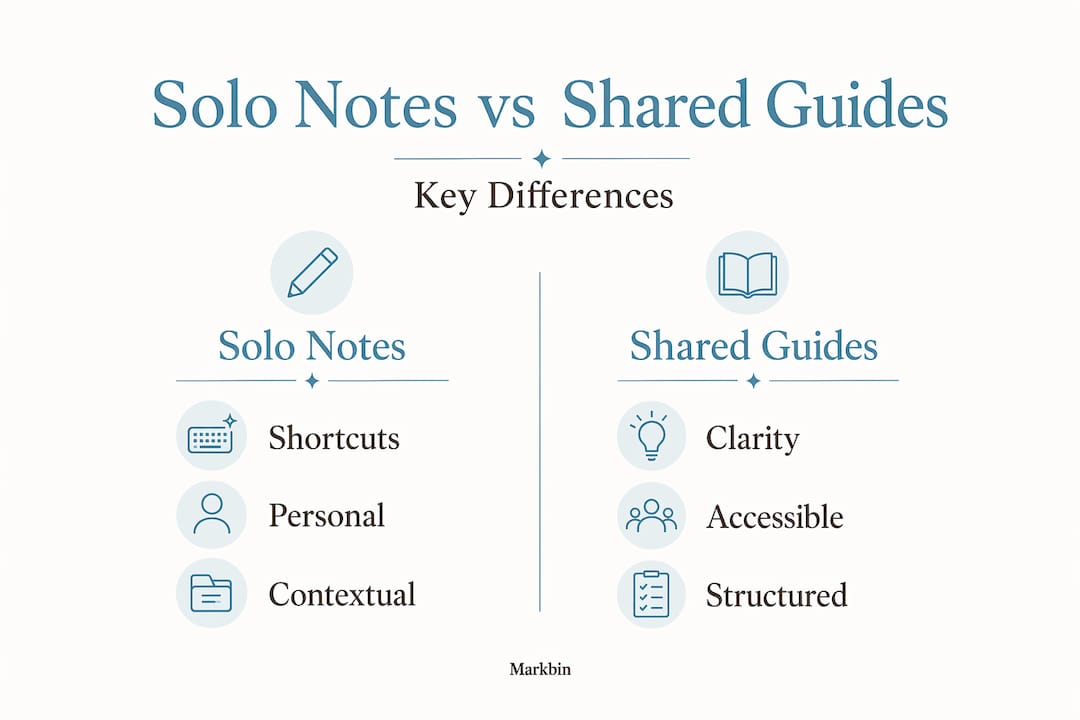
The difference from solo notes is practical. Personal notes are shorthand. They rely on memory and context that only the writer has. Shareable guides assume the reader knows nothing beyond the course itself. That constraint forces better writing and better organization, which, as a side effect, tends to make them more useful even for the person who created them.

Formats and technologies for distribution
Getting the format right is where most shareable study materials fail. A brilliant guide that lives in a file format nobody can easily open is functionally useless. There are a few formats worth knowing.
Digital formats that actually work
PDF is the most familiar option. It preserves layout across devices and is easy to send. The downside: it is static. Nobody can add to it or update it once distributed, and version control becomes a mess fast.
HTML offers much more flexibility. Self-contained HTML files eliminate server dependency and stay fully responsive on desktop, tablet, and mobile. You can embed everything, and the recipient needs only a browser.
Markdown has become the format of choice for technical and academic writers. It is plain text that renders beautifully, supports tables, code blocks, math formulas, and task lists, and can be converted to HTML, PDF, or other formats on demand. Platforms that render GitHub Flavored Markdown (GFM) make it especially powerful for science, engineering, and programming courses.
| Format | Best for | Editing after share | Device compatibility |
|---|---|---|---|
| Final, polished handouts | Not practical | Excellent | |
| HTML (self-contained) | Cross-device access, no login | Requires source file | Excellent |
| Markdown via link | Collaborative, living documents | Yes, with version tracking | Excellent |
| Google Docs / shared cloud | Real-time group editing | Yes | Good (requires account) |
How AI and collaborative tools change the process
AI-powered study guide generators now synthesize multiple course sources into unified, editable documents, including practice questions, in minutes. This is worth knowing, but the output still needs a human review pass. AI tools are good at structure and coverage; they are less reliable at identifying which concepts actually matter most for a specific exam.
Cloud platforms let groups share documents without downloads, but requiring accounts before someone can open a guide reduces participation. The fewer clicks between sharing and reviewing, the higher the engagement. This is not a minor point. It is the most overlooked reason study guides go unused.
Pro Tip: When you share a guide as a public link rather than a file attachment, you eliminate the "I can't open this" problem entirely and make it easier to update the guide without resending it. Read more about why shareable links replace attachments in collaborative contexts.
Best practices for designing effective study guides
Knowing how to create study guides that actually get used requires thinking about structure, learning science, and readability at the same time. Here is a reliable sequence.
-
Define the scope first. Start by listing every topic the exam or course covers. Then rank topics by weight and likely difficulty. This prevents the most common mistake: spending 80% of the guide on topics worth 20% of the assessment.
-
Use the Feynman technique for explanations. Write each concept as if explaining it to someone who has never taken the course. If you cannot do that, you do not understand it well enough yet. This produces explanations that are genuinely useful for group members with varying levels of background knowledge.
-
Add active recall prompts. Every major section should end with 2 to 3 questions the reader must answer without looking up. Effective study schedules built around 45 to 90 minute deep-study sessions prevent cognitive fatigue and reinforce retention better than marathon review sessions.
-
Include worked examples and error logs. A worked example shows the process, not just the answer. An error log, a short list of common mistakes and why they happen, adds a layer of practical value no textbook provides.
-
Control length ruthlessly. A 40-page guide is not a study guide. It is a second textbook. Aim for the minimum length that covers the scope. Every sentence that does not help someone answer an exam question or understand a concept should be cut.
-
Design for scanning. Use headers, bold key terms, and short paragraphs. Someone should be able to skim the guide in five minutes and know exactly where to go for any topic.
Pro Tip: Focusing study periods in 25 to 50 minute intervals with short breaks improves retention more than sitting for two hours straight. Build that recommendation into your guide by dividing content into sessions of that size.
Research from cognitive science backs the structural approach. Structured templates help students innovate and adapt material faster, improving problem-solving speed by up to 23%. The key is giving people a reusable framework, not just a document.
Some of the strongest exam performers take this further by integrating notes directly into their primary course materials, creating all-in-one revision systems that reduce the cognitive cost of switching between sources during high-pressure review sessions.
When and how to use shared guides for group and solo study
Shareable study guides are not always the right tool. Understanding when they help and when they hurt will save your group a lot of wasted time.
The benefits of group study with a shared guide are real and well-documented:
- A shared guide acts as a dynamic agenda, reducing conflict over what to cover and keeping sessions focused.
- It externalizes knowledge, so the group debates the material rather than debating what the material is.
- It distributes cognitive labor. Different group members can own different sections, reducing total preparation time.
But the research has limits worth respecting.
| Context | Shared guide effectiveness | Why |
|---|---|---|
| Groups of 3 to 5 people | High | Accountability stays personal; contributions are visible |
| Groups of 6 or more | Lower | Accountability diffuses in larger groups; social loafing increases |
| Conceptual or applied subjects | High | Discussion adds interpretation; shared examples multiply understanding |
| Dense memorization tasks | Lower | Solo spaced repetition outperforms group study for pure recall |
Shared guides are most effective when the bottleneck in your group is accountability or disagreement about what the material means. If everyone knows what to study but nobody is doing it, a shared guide with assigned sections solves that. If the problem is pure memorization of vocabulary or formulas, individual flashcard systems and spaced repetition will serve you better than a group document.
The practical takeaway: use a shareable guide to build understanding and coordinate effort. Use solo methods to drill what you have already understood.
My take on where most study guides go wrong
I've seen hundreds of study guides over the years, and the most common failure isn't content quality. It's distribution friction. Someone spends three hours building a genuinely good document, then shares it as an email attachment that half the group never opens, or uploads it to a platform that requires a login the rest of the group doesn't have. The guide dies in transit.
The second failure is treating shareability as a formatting question rather than a design question. People spend time making a guide look polished and then pack it with walls of text that nobody will actually read. What I've found actually works is treating the guide like a conversation, not a textbook. Short, confident explanations. Questions built in. Space for the reader to engage.
My contrarian view: the best study guides are built collaboratively from the start, not created by one person and then shared. When group members each write one section using the Feynman technique, the quality goes up, the time investment per person goes down, and everyone arrives at the review session having already processed their section deeply. That is where instant link sharing for collaboration changes the game. A living document shared via link, not a static file, means the guide can be updated as the group's understanding evolves right up until exam day.
The friction point I keep coming back to is this: if sharing your guide requires the recipient to do anything other than click a link, you will lose people. Every extra step cuts participation. Design for the laziest possible access path, not because your group is lazy, but because friction is the enemy of good intentions.
— Zack
Create and share study guides with Markbin
Markbin is built for exactly the kind of document that makes a great shareable study guide. You write in markdown, and Markbin converts it into a beautifully rendered, instantly shareable document accessible via a single link, no account required for the recipient. It supports tables, math formulas, syntax-highlighted code, and task lists, so whether you are preparing for a chemistry exam or a software engineering course, the format handles it. Educators can distribute guides to an entire class in seconds. Students can collaborate on living documents and share updated versions without resending files. Markbin also offers password protection for sensitive materials and self-destructing links for time-limited access. You can also learn more about sharing classroom instructions via link to see how educators are already using this workflow.
FAQ
What makes a study guide shareable?
A study guide is shareable when it is structured for clarity, accessible without special software or accounts, and designed so someone unfamiliar with the creator's personal shorthand can understand and use it immediately.
What format works best for shareable study materials?
Markdown rendered as a shareable link and self-contained HTML files both work well because they require no login and open on any device. PDFs work for finalized, static handouts.
How many people should share one study guide?
Research shows groups of 3 to 5 people get the best results. Larger groups tend to suffer from accountability diffusion, where individual contribution drops as group size increases.
When should you use a solo study method instead?
For dense memorization tasks like vocabulary lists or formulas, solo spaced repetition outperforms group study with a shared guide. Use shared guides when interpretation, discussion, or accountability is the bottleneck.
How long should a study guide be?
There is no fixed rule, but shorter is almost always better. A guide should cover the exam scope in the minimum space needed. If a section does not help someone answer a question or understand a concept, it does not belong in the guide.