
Why secure document sharing matters more than most teams realize
Every day, contracts move through email threads, financial reports land in shared drives with open permissions, and sensitive client data gets forwarded to the wrong inbox. The consequences range from a compliance violation to a full-scale data breach. Secure document sharing protects sensitive information from unauthorized access, keeps organizations on the right side of regulations like GDPR, HIPAA, and PCI-DSS, and gives teams genuine control over who sees what and when.
Here is why it belongs at the center of your information security strategy:
- Data protection: Sensitive files, including contracts, health records, and financial reports, need encryption and access controls to prevent unauthorized viewing or theft.
- Regulatory compliance: GDPR, HIPAA, and PCI-DSS all require strict control and auditability over how sensitive data is shared.
- Controlled collaboration: Secure sharing lets teams work together without losing visibility into who has accessed, edited, or forwarded a document.
- Breach prevention: Uncontrolled document distribution creates permanent copies across servers and inboxes that cannot be recalled after the fact.
- Reputational defense: A single leaked document can erode client trust and trigger regulatory scrutiny simultaneously.
What secure document sharing actually means for your organization
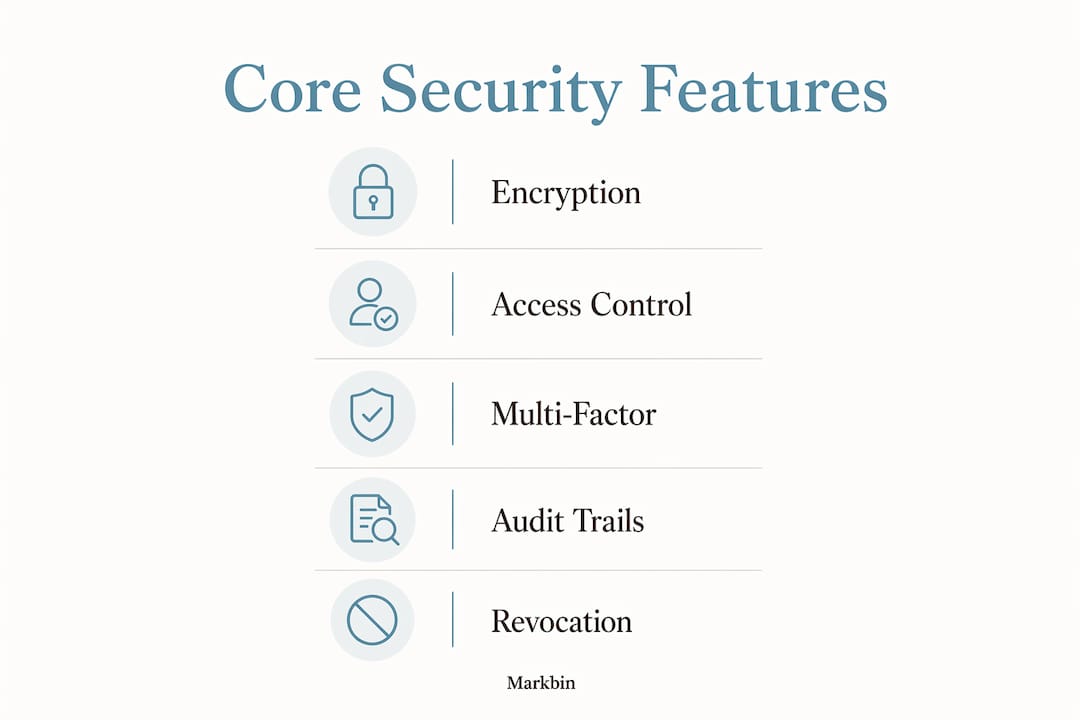
Secure document sharing is not just password-protecting a ZIP file. It is a set of overlapping controls: encryption that scrambles file contents during transit and at rest, access controls that restrict who can open or edit a document, and audit trails that log every interaction with a file. Together, these layers give organizations visibility and control that standard email simply cannot provide.
Privacy matters both inside and outside the organization. An employee forwarding a client contract to a personal email account is just as much a risk as an external attacker. Role-based permissions address this by limiting access to only those whose job requires it.
The risks of insecure sharing compound quickly:
- Uncontrolled copies: Email attachments create permanent copies across multiple servers and inboxes that survive indefinitely and cannot be revoked.
- Accidental forwarding: A misaddressed email or an accidental "Reply All" can expose confidential information to dozens of unintended recipients.
- Version chaos: Multiple copies of a document circulating through email make it impossible to confirm which version is current or authoritative.
- No visibility: Traditional sharing methods leave no record of who opened a file, when, or what they did with it.
Core security features every secure sharing platform should have
Not all platforms marketed as "secure" deliver the same level of protection. Decision-makers evaluating secure document sharing solutions should look for a specific set of technical and functional capabilities.

Encryption standards form the foundation. Data in transit should be protected by TLS 1.3, while data at rest requires AES-256 encryption. These are the industry benchmarks, not optional extras.
Granular access controls go beyond a single password. Effective platforms support user authentication, role-based permissions (view-only, comment, edit, download), and identity verification layers that confirm a recipient's identity before granting access.
Audit trails are what turn security from a promise into a provable fact. A proper audit trail records who viewed a document, when, for how long, and on what device. That data is indispensable for compliance investigations and internal security reviews.
Advanced controls separate capable platforms from basic ones:
- Link expiration dates that automatically cut off access after a set period
- Instant link revocation when a deal falls through or a recipient changes
- Dynamic watermarks that embed the viewer's email address or IP into the document, deterring intentional leaks
- Download blocking that allows viewing without enabling local copies
- Password protection layered on top of link-based access
| Feature | Email attachment | Secure link sharing |
|---|---|---|
| Access control | None after sending | Revoke anytime |
| Expiration | Never | Set time limits |
| Recipient verification | Anyone can open | Require email or password |
| Audit trail | None | Full view history |
| Download control | Cannot prevent | Block downloads |
| Version updates | Must resend | Update in place |
Pro Tip: When evaluating platforms, test the revocation feature first. If you cannot cut off access to a document in under 60 seconds, the platform is not built for real security workflows.
Compliance requirements that make secure sharing non-optional
Regulatory frameworks do not treat document security as a best practice. They treat it as a legal obligation, and the penalties for getting it wrong are steep.
GDPR requires organizations handling EU residents' personal data to implement appropriate technical measures for data protection, including during transmission. Violations can result in fines of up to 4% of global annual revenue.
HIPAA mandates that covered entities and their business associates protect protected health information (PHI) through access controls, audit controls, and transmission security. Sharing PHI over unencrypted email or unsecured platforms is a direct HIPAA violation.
PCI-DSS governs how payment card data is handled and transmitted. Any document containing cardholder data must be shared through channels that meet PCI-DSS encryption and access control requirements.
Beyond fines, non-compliance carries:
- Civil litigation: Clients and partners whose data was exposed can pursue legal action.
- Regulatory investigations: A breach often triggers an audit that examines your entire data handling practice, not just the incident.
- Reputational damage: Public disclosure of a breach or compliance failure can permanently alter how clients and partners perceive your organization.
Secure sharing also supports the proof requirements that regulators demand. Audit trails provide documented evidence of who accessed sensitive data and when, which is exactly what a compliance investigation requires. Version control ensures that the document a recipient viewed matches the authoritative version on record. Consent management features track when and how recipients acknowledged terms.
| Regulation | Core requirement | Secure sharing role |
|---|---|---|
| GDPR | Protect personal data during transmission | Encryption, access controls, audit logs |
| HIPAA | Safeguard PHI with access and audit controls | Role-based permissions, transmission security |
| PCI-DSS | Secure cardholder data in transit and at rest | TLS 1.3, AES-256, access restrictions |
Financial services organizations dealing with ICT backup and audit requirements under frameworks like DORA face additional obligations around data segregation and logging that secure sharing platforms directly address.
How specific industries gain from secure document sharing
The benefits of secure file sharing are not abstract. They show up differently depending on the sector, and the stakes vary accordingly.
Healthcare organizations transmit patient records, lab results, consent forms, and referral documents constantly. A single unsecured transmission of PHI can trigger a HIPAA investigation. Secure platforms with email verification and audit trails let clinical teams share records with specialists, insurers, and patients without creating uncontrolled copies in personal inboxes.
Legal practices handle contracts, settlement agreements, discovery documents, and retainer agreements. Emailing these files creates version control problems and leaves no proof of delivery. Secure link sharing solves both: the recipient accesses the current version through a controlled link, and the audit log confirms exactly when they viewed it.
Finance teams share pitch decks, due diligence packages, and financial statements with investors, auditors, and regulators. The financial services sector faces particular exposure when sensitive deal documents circulate through email. A data room with granular permissions, view-only access, and instant revocation replaces the chaos of emailing attachments to dozens of stakeholders.
HR and operations departments handle employment contracts, performance reviews, compensation data, and onboarding documentation. Secure onboarding document workflows using controlled links prevent sensitive employee data from sitting in email threads indefinitely.
Intellectual property protection cuts across every sector. Design files, product roadmaps, and proprietary research shared through unsecured channels can end up with competitors. Watermarking and download controls reduce that risk without blocking legitimate collaboration.
Secure sharing also builds trust with external stakeholders. Clients who receive a secure, verified link rather than a raw email attachment see a signal that your organization takes their data seriously. That perception matters in competitive markets where trust is a differentiator.
Emerging risks and expert best practices in secure document sharing
The threat environment around document sharing has shifted. Malware increasingly targets trusted document formats like PDF, Word, and PowerPoint precisely because recipients open them without hesitation. Attack vectors include malicious JavaScript embedded in PDFs, Office macros that execute on open, and OAuth phishing links hidden inside documents. The format's trustworthiness is the exploit.
94% of organizations reported security incidents involving email, which makes it the highest-risk channel for sensitive document exchange. Yet most teams still default to email attachments for contracts, financial reports, and client data.
The shift that matters: Moving from uncontrolled attachments to centralized link-based sharing is not just a feature upgrade. It transfers control back to the sender, enabling revocation, expiration, and monitoring that attachments structurally cannot support.
Expert recommendations for organizations implementing or upgrading their approach:
Move to link-based sharing. Shareable links replace attachments by keeping the document on controlled infrastructure. The sender retains the ability to revoke, update, and monitor access after the link is sent.
Use Data Loss Prevention (DLP). DLP combined with continuous monitoring and automated retention policies addresses both insider threats and external attacks. Static encryption alone does not catch an authorized user sharing a file with an unauthorized recipient.
Require multi-factor authentication (MFA). A link plus a password is stronger than a link alone. For highly sensitive documents, requiring email verification or a one-time code adds a layer that stops casual unauthorized access cold.
Strip metadata before sharing. Sensitive metadata embedded in documents, including tracked changes, hidden comments, and EXIF data in images, can leak confidential information even when the document content itself is protected. Remove it before the file leaves your control.
Never use "anyone with a link" access for sensitive files. Open link sharing is a major vulnerability. Explicit, identity-based access controls are the only way to know who actually has access to a document.
Separate your passphrase from your file link. Sending decryption keys in the same email thread as the document link hands an attacker everything they need in one place. Use a separate communication channel for any passphrase or access credential.
Pro Tip: Revoke links you no longer need active on a regular schedule. Dormant links to old pitch decks, draft contracts, or internal reports are a silent exposure risk that accumulates over time.
Markbin addresses several of these concerns directly. Its password protection, self-destructing document links, and instant sharing without requiring recipient sign-up give teams a practical path to secure link-based sharing without adding friction to everyday workflows. For teams working in markdown, that combination of security and simplicity is genuinely useful.
Key Takeaways
Secure document sharing protects sensitive business data, satisfies regulatory requirements under GDPR, HIPAA, and PCI-DSS, and gives organizations the access control and audit visibility that email cannot provide.
| Point | Details |
|---|---|
| Email is a high-risk channel | 94% of organizations reported security incidents involving email, making it unsuitable for sensitive documents. |
| Encryption standards matter | TLS 1.3 in transit and AES-256 at rest are the industry benchmarks for protecting shared files. |
| Compliance demands proof | GDPR, HIPAA, and PCI-DSS require audit trails and access controls, not just encrypted storage. |
| Link-based sharing restores control | Revocable links with expiration dates replace uncontrolled email attachments that cannot be recalled. |
| Metadata is a hidden risk | Tracked changes, hidden comments, and EXIF data can leak confidential information even in encrypted files. |