
Why guest post link building still works
Guest post link building is the practice of pitching original content to external websites in exchange for a backlink to your site. You write something genuinely useful for their audience; they publish it with a link back to you. Done right, it builds domain authority, drives referral traffic, and puts your brand in front of readers who already trust the publication.
The reason it keeps working is simple: editorial backlinks from real, high-authority sites carry weight that directory links and profile links never will. When you distribute guest post pitches via link sharing, you are not just chasing a backlink. You are earning a placement that signals credibility to both Google and human readers.
Key benefits worth knowing:
- Improved search rankings through authoritative, editorially placed backlinks
- Referral traffic from engaged audiences on relevant sites
- Brand authority built by appearing on publications your audience already reads
- Relationship building with editors who may invite future contributions
- Topical relevance signals when the linking site covers your niche
Tools like Respona automate much of the prospecting and contact-finding work, letting you focus on pitch quality rather than spreadsheet management. The outreach process itself, though, still lives or dies on how well you understand the editor's needs before you write a single word.
How to find guest post opportunities effectively

Most guest post opportunity lists are recycled. Everyone is pitching the same "Write for Us" pages, which means you are competing with every other SEO professional who ran the same Google search. The better approach is to find sites that accept guest posts without advertising it.
Start with search operators like site:domain.com "guest post" or site:domain.com "contributed by" to surface real editorial placements rather than paid link farms. These queries reveal sites that have published guest content organically, which is a much stronger signal of editorial quality than a "Write for Us" landing page built around fees.
Pull a competitor's backlink profile in Ahrefs or Semrush and filter for links coming from contributed articles. If a site published a guest post for a competitor, it will likely publish one for you. This method consistently surfaces better targets than any public list.
A few practical filters before you add a site to your outreach list:
- Domain authority and traffic: Use Semrush or Ahrefs to confirm the site has real organic traffic, not just a high DA from old links.
- Editorial standards: Real author bios, named contributors, and substantive articles are good signs. Thin posts from anonymous authors are not.
- Outbound link patterns: Relevant contextual links are fine. Obvious commercial anchors in every post signal a link farm.
- Audience engagement: Comments, social shares, or visible community activity suggest a real readership.
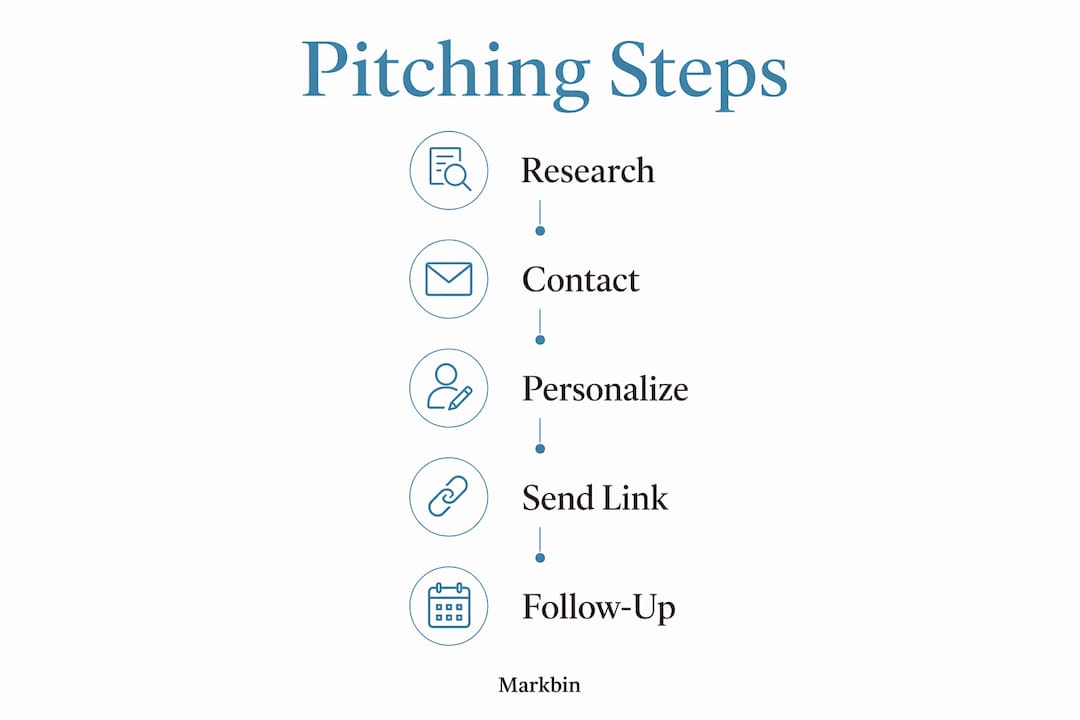
Once you have a target site, find the right person. Sending a pitch to info@ or contact@ is where most campaigns quietly fail. Start on LinkedIn, filter by "editor," "content," or "SEO," and get a name. Then use a domain email lookup tool to find the verified address.
Pro Tip: Emailing more than one relevant contact at the same organization, such as both the content editor and the SEO lead, meaningfully increases your response rate. You often cannot tell from the outside who actually approves guest submissions.

How to craft and distribute impactful guest post pitches via link
The most common reason pitches fail is not bad writing. It is a generic template that could have been sent to any site in any niche. Editors at high-authority publications receive pitches constantly, and they can spot a mass-send in the first sentence.
The fix is a pattern interrupt: open with something specific to that site. Reference a post they published in the last 30 days, name the gap it left open, and propose your article as the piece that fills it. That single move separates your pitch from the pile. Focusing on editorial value and missing angles, rather than leading with your credentials or your link target, is consistently more effective.
Pitch structure that works:
- Subject line: Specific, under 8 words, names the site and topic. "Guest post idea for [Site]: [Title]" works. "Collaboration opportunity" does not.
- Opening line: One sentence referencing a real, recent article by title.
- Topic proposal: Two to three sentences framing the idea as value for their readers, not for you.
- Credibility marker: One sentence, specific and verifiable. Link to a relevant published piece.
- Call to action: "Want a full outline?" is easier to answer than "Let me know your thoughts."
- Total length: Under 200 words. Editors read these on their phones.
Use a shareable writing portfolio link rather than attaching PDFs. A clean, rendered link is faster to open and looks more professional than a file attachment that may not render correctly on every device.
For scaling, a tiered personalization approach keeps quality high without burning hours on every pitch:
| Tier | Site authority | Personalization level | Expected reply improvement |
|---|---|---|---|
| Tier 1 | High DA | Full custom, every element | Highest |
| Tier 2 | Medium DA | Template + 4 custom fields | Moderate |
| Tier 3 | Lower DA | Template + 2 custom fields | Baseline |
A mixed approach of standardized templates combined with manual personalization at scale lets you run efficient campaigns without sacrificing the editorial fit that gets replies. Sending schedules matter too: optimal outreach lands Tuesday through Thursday, 9–11 AM in the editor's timezone, with a limit of 10 emails per sending account per day to protect deliverability.
Pro Tip: In 2026, explicitly stating that your content is 100% human-written is a genuine selling point. Editors at Tier 1 publications are actively filtering out AI-generated submissions. A one-line guarantee in your pitch removes a real objection before it forms.
Follow-up is where most outreach campaigns leave placements on the table. A Day 7 follow-up that adds a new data point or a related angle performs far better than a simple "bumping this to the top of your inbox." Give the editor a reason to reconsider, not just a reminder that you exist.
How to pitch sites that don't have a "Write for Us" page
Sites without an explicit guest post page are often the best targets. Avoiding "Write for Us" pages tends to lead to higher-quality placements because those pages attract paid link requests rather than genuine editorial pitches. The absence of a submission page does not mean the site never accepts contributions. It usually means they are selective.
The keyword gap pitch is the most effective approach here. Run the target site against two or three competitors in Ahrefs or Semrush. Find keywords where competitors rank in the top 100 but the target site does not. Those gaps are your pitch. Include a screenshot of the keyword data in your email. It shows you did the research, and it gives the editor a concrete reason to say yes.
Do's when pitching sites without a guest post page:
- Research the site thoroughly before reaching out. Read at least five recent posts.
- Propose a specific topic with a clear angle, not an open-ended offer to "write something."
- Include a link to a relevant published piece as proof of quality.
- Frame the pitch around their audience's benefit, not your link target.
- Use a shareable methodology document or case study reference to demonstrate original thinking.
Don'ts:
- Do not mention paid placements or ask about "sponsored" options in a first pitch.
- Do not send the same template you used for sites with submission pages.
- Do not pitch a topic they have already covered. Run a quick
site:[domain] "[keyword]"check first. - Do not lead with your credentials. Lead with their content gap.
Google's spam policies explicitly prohibit paid do-follow links that pass ranking credit. Any site offering guaranteed placements for a fee is selling a footprint risk, not a backlink. The occasional correctly tagged sponsored post is a different matter, but bulk paid packages create patterns that can damage your client's rankings rather than lift them.
Strategies for tracking and managing guest post pitches distributed via links
Sending pitches without a tracking system means you cannot improve what you cannot measure. A basic placement log should capture the host domain, the live URL, the target page, the anchor text used, the link attribute (followed, nofollow, or sponsored), and the indexation status.
Set a recurring check at 7 days and 21 days post-publication to confirm each placement is indexed. Automated indexation checks at those intervals, with manual intervention for any placement not indexed by day 21, protect the SEO value of every link you earn. Submit the URL via Google Search Console and consider building one supporting link to the guest post if it remains unindexed.
For pitch pipeline management, a simple CRM or project management board works well. Track each prospect through these stages:
- Identified: Site qualifies, contact found, not yet pitched.
- Pitched: Initial email sent, awaiting reply.
- Followed up: Day 7 value-add sent.
- Accepted: Editor confirmed interest, article in progress.
- Published: Live URL confirmed, indexation check scheduled.
- Indexed: Confirmed in Google Search Console, ranking impact being monitored.
Anchor text distribution deserves attention at scale. When you are running multiple campaigns simultaneously, exact-match anchor concentration can drift toward over-optimization without anyone noticing until it becomes a visible pattern. Reviewing anchor text spread across all placements per client, and flagging campaigns where exact-match concentration is climbing, catches the problem before it creates a Google-visible footprint.
For sharing pitch materials and campaign documentation with clients or team members, Markbin lets you convert markdown tracking documents into clean, shareable links instantly, without requiring the recipient to sign up for anything. That keeps your workflow tight and your client reporting professional.
Tips for optimizing email and social media link sharing for guest post outreach
Email deliverability is the silent killer of outreach campaigns. A pitch that never reaches the inbox is a pitch that never gets read. Before any campaign goes live, confirm your sending domain has proper SPF, DKIM, and DMARC records in place. Warm up new mailboxes gradually rather than jumping straight into volume sends. Verify every email address before sending; a bounced email chips away at your domain's sending reputation, and enough bounces drag down deliverability across the whole campaign.
Subject lines deserve more attention than most outreach guides give them. Specific subject lines that name the site and the topic outperform vague phrases like "quick question" or "collaboration opportunity" by a wide margin. Editors mentally filter generic subjects before the email even opens. Keep it under 8 words, make it specific, and skip the clever phrasing.
Social media, particularly LinkedIn and X (formerly Twitter), opens a channel that most outreach campaigns ignore entirely. Editors and content leads at major publications regularly post pitch requests and content needs on both platforms. Following the editorial staff at your target publications, engaging with their content genuinely before you pitch, and joining relevant Slack communities or industry Facebook groups puts you in front of decision-makers in a context where you are not competing with a hundred cold emails.
A few practical optimizations worth building into every campaign:
- List hygiene: Remove unresponsive contacts after two follow-ups. A clean list protects deliverability and keeps your pipeline accurate.
- Reply detection: Use your outreach tool's reply detection to stop sequences automatically when an editor responds. Sending a follow-up after someone has already replied is a fast way to lose a placement.
- Personalized link assets: When sharing portfolio samples or pitch decks, use a tool like Markbin to create rendered, shareable markdown links rather than sending raw files. A clean link loads instantly, looks polished, and works on any device.
- Timing consistency: Stick to the Tuesday through Thursday, 9–11 AM window. Sending outside that window is not a campaign-killer, but consistency compounds over hundreds of sends.
- Volume discipline: Ten emails per sending account per day is the ceiling for maintaining deliverability. Spiking volume because you built a larger list is how campaigns get flagged.
For SEO and digital marketing insights on identifying legitimate guest posting opportunities and avoiding low-quality link sources, staying current with how editorial standards are shifting in 2026 helps you refine your targeting before you send a single pitch.
Key Takeaways
Distributing guest post pitches via link sharing works when you combine editorial research, tiered personalization, and disciplined follow-up into a repeatable system.
| Point | Details |
|---|---|
| Skip "Write for Us" pages | Search operators and competitor backlink analysis surface higher-quality targets than public submission pages. |
| Personalize by tier | Full custom for High DA sites; template plus custom fields for mid-tier and lower-tier targets. |
| Keep pitches under 200 words | Specific subject lines, one reference to a recent article, and a clear call to action outperform long credentials-heavy emails. |
| Follow up with new value | A Day 7 follow-up adding a data point or fresh angle performs far better than a simple reminder. |
| Track indexation at 7 and 21 days | Manual intervention for unindexed placements protects the SEO value of every link you earn. |