
Instant link content publishing is the process of making digital content available via a shareable URL the moment you finish creating it, with no manual uploads, no server configuration, and no administrative delays. The industry term for this broader practice is automated content distribution, and understanding it is now a core skill for content creators, developers, and educators who need to move fast. What is instant link content publishing in practical terms? It means your document, training module, or technical guide goes live in seconds and stays accessible at a permanent, shareable link. Platforms like Markbin are built around this exact workflow, converting markdown text into a rendered, shareable URL without requiring a sign-up.
What is instant link content publishing and how does it work?
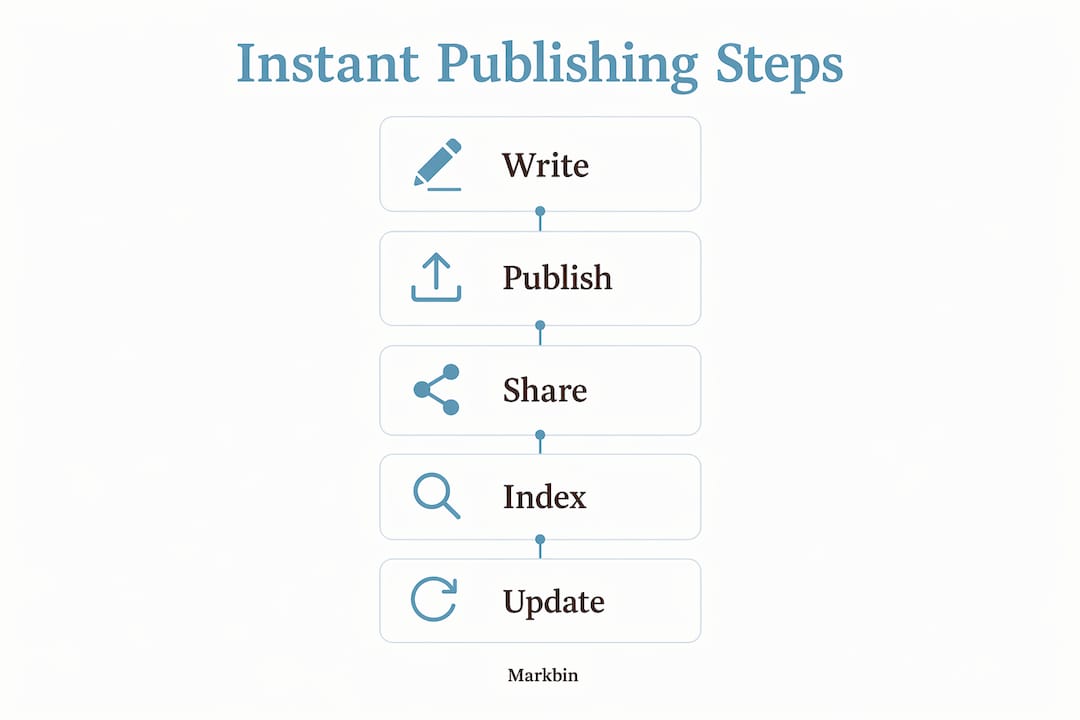
Instant link content publishing works by removing every manual step between content creation and a live URL. Traditional publishing requires uploading files to a server, configuring paths, waiting for build processes, and then distributing a link. Automated publishing collapses all of that into a single action.
The technical backbone relies on three components working together:
- Static content generation. Your content is converted into a lightweight, pre-rendered format. Static publishing platforms deploy this content in under 2 seconds, making it immediately accessible via URL. That speed eliminates the waiting period that used to separate creation from distribution.
- API-driven automation. APIs connect your creation tool to a hosting layer. When you save or submit content, a webhook fires, the content renders, and the URL goes live. Automating via webhooks reduces human error and improves distribution consistency across every publish event.
- Persistent URL management. The link stays constant even when the content updates. Lightweight tools like Markbin's Quick Share model publish to a fixed URL, so you never need to redistribute a new link after an edit. Quick Share tools bypass LMS setup and admin delays entirely, which is a significant time saver for educators managing training content.
One detail most creators miss: instant publishing makes content live, but it does not make content indexed. Search engines still need to discover the new URL. The IndexNow protocol reduces indexing time from days to hours by notifying search engines the moment content goes live. Without it, your content can sit unindexed for days even though it is technically accessible.
Pro Tip: Set up IndexNow or a similar pinging protocol as part of your publishing pipeline. Publishing and indexing are two separate events, and treating them as one is the most common mistake in instant distribution workflows.

What are the main benefits of instant link content publishing?
The core benefit is the elimination of distribution friction. Every manual step between creation and sharing is a point where content gets delayed, lost, or forgotten. Removing those steps changes how quickly teams and audiences can act on new information.
Practical benefits for creators, developers, and educators include:
- Immediate sharing. Content is accessible the moment it is created. A developer can share API documentation with a client before the meeting ends. An educator can distribute a lesson module to students the same morning it is written.
- Live collaboration. Because the URL stays constant and content updates in place, collaborators always access the latest version. There is no version confusion from emailed attachments or stale downloads.
- No platform dependency. Instant link sharing removes the requirement for recipients to log into a platform, install software, or hold an account. The link works for anyone with access.
- Rapid prototyping. Developers and educators use instant publishing to test content with real audiences before committing to a full production build. A training module can go out as a quick-share link, gather feedback, and be revised within the same day.
- Consistent distribution. Automated pipelines push content to the right channels without manual routing. That consistency matters when you are managing multiple content types across a team.
"Eliminating distribution friction by automating from creation to live URL gives creators greater agility in the modern content economy. Speed of distribution is now a competitive advantage, not just a convenience."
The use cases span a wide range. Dashboards, internal reports, onboarding documents, technical tutorials, and team updates all benefit from instant publishing. For educators specifically, the ability to publish a training module and share it via a single link, without any LMS configuration, changes the economics of content delivery entirely.
Pro Tip: Keep your content marketing under control by building instant publishing into your editorial calendar from the start. Retrofitting automation into an existing workflow is harder than designing for it upfront.
What tools and platforms support instant link publishing?
The tools that enable instant link publishing fall into a few clear categories. Understanding the category helps you choose the right fit for your workflow.
| Category | Core capability | Best for |
|---|---|---|
| Static hosting with API | Sub-second deployment via API trigger | Developers building automated pipelines |
| Lightweight share tools | Fixed URL publishing without LMS | Educators and training content creators |
| Markdown rendering platforms | Instant link from plain text input | Writers, researchers, and technical teams |
| Platform-native publishers | Auto-reformats content per channel | Multi-channel content distribution teams |
Static hosting services with open APIs give developers the most control. You write content, trigger a build via API, and a URL is live within seconds. The tradeoff is setup time: these tools require pipeline configuration upfront.
Lightweight share tools sit at the other end of the spectrum. They require no configuration and no recipient accounts. Markbin fits this category. You write in GitHub Flavored Markdown (GFM), which supports syntax highlighting, tables, task lists, and math formulas, and Markbin generates a shareable link instantly. No sign-up is required for either the creator or the reader.
Platform-native publishing adds another layer by automatically adapting content format for different channels before distribution. An AI layer rewrites or reformats content variants for different professional or social contexts, maximizing engagement without manual editing for each channel.
Pro Tip: For technical documentation and team notes, a markdown-based platform like Markbin gives you instant publishing with zero infrastructure overhead. For multi-channel campaigns, add a platform-native layer on top to handle format adaptation automatically.
What challenges should creators watch for with instant publishing?
Instant publishing introduces real risks when creators treat speed as the only goal. The most common pitfall is confusing a live URL with a discoverable one. Instant publishing makes content live immediately, but search engines may still take hours or days to index it without protocols like IndexNow. Creators who expect instant SEO results from instant publishing will consistently be disappointed.
Other challenges worth addressing directly:
- No approval guardrails. Fully automated pipelines can publish errors, outdated information, or off-brand content before anyone reviews it. Successful workflows include approval steps that queue content for review when certain risk criteria are met, rather than auto-publishing everything without a check.
- Security and access control. A public URL is accessible to anyone who has it. For sensitive content, creators need password protection, expiring links, or access-restricted sharing. Markbin addresses this with password-protected documents and self-destructing links that expire after a set time.
- Internal linking gaps. Instant publishing often produces isolated documents with no connection to related content. That hurts both user experience and SEO. Building internal links into your content before publishing, not after, is a discipline that pays off quickly.
- Brand consistency at scale. When multiple team members publish instantly, brand voice and formatting can drift. Style guides and templates enforced at the creation stage prevent this without slowing down the publishing process.
The right approach balances speed with review. Not every piece of content needs a full editorial review, but high-stakes documents, public-facing pages, and anything with legal or compliance implications should pass through at least one checkpoint before going live.
Key Takeaways
Instant link content publishing works best when speed, automation, and quality controls operate together rather than in isolation.
| Point | Details |
|---|---|
| Speed is structural | Static platforms deploy content in under 2 seconds, making the URL live before most manual processes begin. |
| Publishing and indexing differ | Content goes live instantly, but search engine discovery requires IndexNow or similar pinging protocols. |
| Approval guardrails matter | Automated pipelines need review checkpoints to prevent publishing errors or off-brand content at scale. |
| Security requires active choices | Password protection and self-destructing links are necessary for any content not meant for public access. |
| Markdown platforms reduce overhead | Tools like Markbin publish formatted documents instantly with no infrastructure setup or recipient accounts. |
Why instant publishing is the workflow shift I keep recommending
The conversation around instant publishing usually focuses on speed. That is the wrong frame. Speed is a side effect. The real shift is the removal of gatekeeping steps that were never adding value in the first place.
I have watched teams spend more time managing file versions, chasing approvals for low-stakes documents, and re-sending updated attachments than they spend actually creating content. Instant link publishing does not just save time. It removes an entire category of coordination overhead that most teams have normalized without questioning.
The integration with AI workflows makes this more significant, not less. As AI-assisted writing becomes standard, the bottleneck moves from content creation to content distribution. A creator who can generate a well-structured document in minutes but then waits hours to share it has not actually gained much. Instant publishing closes that gap.
My advice for creators in 2026: adopt instant publishing for internal documents first. Team updates, meeting notes, and technical specs are low-risk and high-frequency. Build the habit and the tooling there. Then extend it to external content with appropriate security controls in place. The document sharing workflow you build internally will translate directly to how you share with clients and audiences.
The creators who treat distribution as an afterthought will keep losing ground to those who treat it as part of the creative process itself.
— Zack
How Markbin fits into your instant publishing workflow
Markbin is built for creators, developers, and educators who need to publish formatted content instantly without managing infrastructure. You write in GitHub Flavored Markdown, and Markbin generates a shareable link immediately. No account is required for readers, and no server configuration is required for creators. Features like password protection, self-destructing documents, and full GFM support, including syntax highlighting, tables, and math formulas, make it practical for both sensitive internal documents and public-facing technical content. For teams that need fast, clean document sharing without platform overhead, Markbin removes every unnecessary step between writing and sharing.
FAQ
What is instant link content publishing in simple terms?
Instant link content publishing is the process of making digital content available via a shareable URL immediately after creation, with no manual upload or configuration required. The content goes live in seconds and is accessible to anyone with the link.
How is instant publishing different from traditional web publishing?
Traditional publishing requires manual file uploads, server configuration, and build processes that can take minutes or hours. Instant publishing uses automated pipelines and static hosting to deploy content in under 2 seconds.
Does instant publishing mean my content is immediately indexed by Google?
No. Instant publishing makes content live but does not guarantee immediate search engine indexing. Protocols like IndexNow notify search engines upon publishing and reduce indexing time from days to hours.
What security options exist for instantly published content?
Creators can use password-protected links, expiring or self-destructing documents, and access-restricted sharing to control who sees instantly published content. Markbin offers password protection and self-destructing document features natively.
Who benefits most from instant link content publishing?
Developers sharing technical documentation, educators distributing training modules, and content creators managing team updates benefit most. The core advantage is removing coordination overhead from high-frequency, low-risk document sharing.